
Four Quarters In Jerusalem Old City: Best Places To Visit In 2026 (With Map)

Looking for things to do and answers to your questions about the Four Quarters in Jerusalem? You’re in the right place!
The 4 quarters are located within Jerusalem’s Old City: The Armenian Quarter, Christian Quarter, Jewish Quarter and Muslim Quarter. Some also consider the Temple Mount to be its own fifth area.
Consider this post your guide to the Four Quarters: Where they are, why and how they were divided, what to see in each, and even more tips for what to see in Jerusalem, how to get around and where to stay!
Why listen to me? I lived in Israel for two years in addition to many visits here. Most of my time was spent on archaeological digs and study, including a Masters degree at Tel Aviv University – which means I’ve been in both the tourist areas and behind-the-scenes!

Planning Your Jerusalem Trip? Use my favorite resources:
Accommodation: Booking.com
Mid-Priced Hotel: Bezalel Hotel
Rent a Car: Discover Cars
Travel Insurance: Allianz
Flights: WayAway
Tour: All Inclusive Walking Tour Old City Jerusalem
Airport Transfers: KiwiTaxi
Four Quarters In Jerusalem Map (+ Bonus Places)
Four Quarters In Jerusalem: An Introduction

The Old City of Jerusalem is called the “center of the world” because of its ancient history and the world religions that count this area as their holiest, making it possibly the most culturally significant place on Earth.
The Old City and its walls are also a UNESCO World Heritage Site.
The Old City is just a small part of modern-day Jerusalem, at only 0.35 square miles (the modern city of Jerusalem is 48.3 square miles). However, this area was the entire city of Jerusalem until 1860, and it lies within the walled area.
In traditional thought, this is the area King David made as the capital for the Jewish people until the 10th century BCE.
Today, most archaeologists believe, based on archaeological findings, that the original settlement of Jerusalem was actually centered in the City of David during the Bronze and Iron Ages, and possibly beyond to Mount Zion and the Temple Mount.
Read on to learn more about what to see in this area, too!
When, Why & How was Jerusalem divided into 4 quarters?

Here’s a quick history lesson to understand the 4 Quarters, or Quadrants, of the Old City:
- 70 CE: The Jewish Temple was destroyed by the Roman emperor Vespasian, leaving only the Western Wall that can be visited today.
- 66-136 CE: Three major Jewish revolts against Rome took place: The First Jewish–Roman War, the Kitos War & the Bar Kokhba Revolt.
- 129/130 CE: Hadrian rebuilt Jerusalem, adding the 4 quarters, and re-named the city Aelia Capitolina. He also built a statue of Jupiter and one of himself on the Temple Mount, where the Jewish Temple had stood prior to 70 CE.
- 7th century CE: The Dome of the Rock & Al-Aqsa Mosque were built on the former Temple site, known as the Temple Mount.
- 1948: The War of Jewish Independence took place, and the Old City became occupied by Jordan. The Jordanians kicked out the Jewish residents and destroyed the Jewish Quarter.
- 1967: The Six-Day War took place, and Israel liberated the Old City.
It was only in the 19th century when the four quarters became known as they are today. Population-wise, the 4 quarters have not been cleanly divided into populations of only their namesakes, which has prompted conflicts at various times.
Here’s more information about each quarter, including a brief history and what to see in each!

Four Quarters In Jerusalem: What to see in every quarter
1. The Shuk
David Street runs from the Christian Quarter to the Muslim Quarter, and is the area where the market, or shuk, exists where tourists can buy souvenirs and more things.
The Christian Quarter has a lot of Christian-themed items, as well as some Judaica (but you’ll find the best Judaica in the Jewish Quarter). The Muslim Quarter caters mostly to locals, and you’ll find a lot of imported items being peddled to tourists here.
Tip: You should always haggle at the tourist shops, but not at the produce stalls.
Shuk Hours: Sat-Thurs: 9am–7pm
2. Restaurants
While you’re in each quarter, there are restaurants unique to each culture represented! I recommend trying Armenian food in the Armenian Quarter in particular, for something not as common throughout your trip!
3. Holidays
Each quarter has decorations, concerts, services and more for each holiday. The Armenian Quarter observes the Julian calendar, so Christmas and New Year’s are observed on different dates there, for example!
In the Jewish Quarter during the High Holy Days, you’ll see more crowds at the Western Wall (especially on Shavuot, when it’s customary to stay up all night reading the Torah)!
In the Muslim Quarter, Ramadan is the biggest holiday and you’ll notice crowds and more events going on.
Likewise, in the Christian Quarter, Christmas is a great time to make a pilgrimage to see the decorations, concerts and attend services.
The Jewish Quarter Market (Shuk): Embedded within the ancient streets of the Jewish Quarter, the market is a vibrant hub where locals and visitors converge. Offering a sensory delight, the market boasts stalls with fresh produce, aromatic spices, and a myriad of traditional goods.
- Atmosphere: Bustling market ambiance in the heart of the Old City.
- Products: Fresh produce, spices, traditional goods.
Festivals and Holidays in the Jewish Quarter:
Hanukkah: The Jewish Quarter comes alive during Hanukkah, with menorahs illuminating the narrow streets. Festive celebrations, traditional songs, and the aroma of sufganiyot (jelly-filled doughnuts) create a joyous atmosphere.
- Highlights: Menorah lighting, traditional songs, sufganiyot.
Passover (Pesach): Passover in the Jewish Quarter is marked by special meals, symbolic rituals, and the recounting of the Exodus story. Visitors can experience the unique atmosphere of Passover through communal Seders and cultural events.
- Activities: Passover Seders, cultural events.
Shabbat Celebrations: Each Friday evening, the Jewish Quarter transitions into Shabbat mode. The sound of synagogue prayers, families gathering for festive dinners, and a serene atmosphere contribute to the sacred experience of Shabbat.
- Experience: Synagogue prayers, festive dinners, serene ambiance.
Restaurants and Cafés in the Jewish Quarter:
Café Aroma: Situated amidst the historic charm of the Jewish Quarter, Café Aroma offers a cozy retreat. Patrons can savor aromatic coffees, freshly baked pastries, and light meals while enjoying the unique ambiance of the Old City.
- Menu: Aromatic coffees, pastries, light meals.
- Atmosphere: Cozy retreat in the heart of history.
Rimon Café: Rimon Café provides a delightful setting for coffee enthusiasts. Nestled in the Jewish Quarter, it offers a range of coffee blends, delectable desserts, and a welcoming atmosphere.
- Specialty: Coffee blends, delectable desserts.
- Setting: Welcoming ambiance in the Old City.
Eucalyptus Restaurant: For a culinary journey rooted in tradition, Eucalyptus Restaurant is a gem in the Jewish Quarter. Fusing ancient flavors with modern twists, it showcases the richness of Jerusalem’s gastronomic heritage.
- Cuisine: Traditional with modern twists.
- Highlight: Culinary journey in a historic setting.
Morduch Café: Morduch Café is a hidden gem, offering a tranquil escape in the heart of the bustling Old City. Known for its artisanal coffees and pastries, it invites visitors to relax and recharge.
- Specialties: Artisanal coffees, pastries.
- Ambiance: Tranquil escape in the heart of history.
All Inclusive Walking Tour Old City Jerusalem

A lot of the Old City can be tricky to navigate! This All Inclusive Walking Tour in the Old City of Jerusalem is a great way to get a guided tour of all four quarters with a professional guide in a small group and more, including:
- Western Wall & Temple Mount, including the Dome of the Rock
- Church of the Holy Sepulchure
- Lunch with complimentary tea or coffee
- Jaffa Gate
- Armenian Quarter
- Cardo
- Broad Wall
- Hurva Synagogue
- Golden Menorah
- Via Dolorosa
- Deir Al Sultan
🌟 Check out this 5-star review by John_T:
“Fantastic experience. Leontine’s (our guide) command of the history and culture is exceptional. The tour was perfectly paced and timed. The coffee and lunch stops were ideally located. Our guides ability to communicate thousands of years of multi-layered history into a perfectly understandable cohesive attitude was second to none. Exactly the experience we were looking for.”
🐪 Check Availability for This All Inclusive Walking Tour Old City Jerusalem Here
Four Quarters In Jerusalem: The Armenian Quarter
The Armenian Quarter (Hayots t’agh in Armenian) is the smallest quarter and is located in the Southwestern corner of the Old City.
Size: 31 acres Population: Around 2500 people
Enter the Armenian Quarter through the Jaffa Gate or the Zion Gate.
Here’s what to see in the Armenian quarter:
4. Iconic Armenian-Turkish Ceramic Art
Look for the iconic Armenian Turkish-style ceramic art in this quarter! This style is associated with visits to Israel in general, but it was brought to the country by Armenian immigrants and pilgrims in more recent centuries when the Ottoman rulers gave them the task of restoring the 15th-century tiles on the Mosque of Omar.
The ceramics have hand painted elements that are part of their iconicity with Judaica items and more designs!
5. Armenian Museum (Mardigian Museum)
The Mardigian Museum, also known as the Armenian Museum, is an important place to visit to learn about Armenian history and culture, and especially to learn more about the Armenian genocide in Turkey during WWI. Many of the Armenian people living in Jerusalem are children of survivors.
The museum also tells about the Armenians’ connection to Jerusalem, as there have been Armenian people living here for centuries, since the late Roman Empire when monks and pilgrims moved to Jerusalem. The museum was recently renovated (in a 5-year project), and reopened in 2022.
Note: This museum may not be suitable for children, as there are graphic photographs displayed.
Museum hours: Mon-Sat, 9:30am-6:30pm
Ticket Price: 5 Shekels
6. Tower of David

The Tower of David is located in the citadel at the Jaffa Gate, where you can see the citadel itself as well as a museum with permanent and changing exhibitions. Here’s more of what you’ll see:
- Two outdoor tour routes through the archaeological courtyard
- Moat
- The Kishle, an archaeological excavation area which has remains from the First Temple Period through modern times, including Herod’s palace, a Jewish factory from the Middle Ages, a prison & more
- 360° viewpoint from the Phasael Tower
- Nighttime sound & light show (additional cost)
- Tastings from Yalla Basta combined with Tower of David visit (additional cost)
Museum hours: Sat-Thurs 9am-4pm, Fri 9am-2pm (the museum stays open one hour past closing time)
Check this page for ticket prices.
7. St. Mark’s Syriac Church
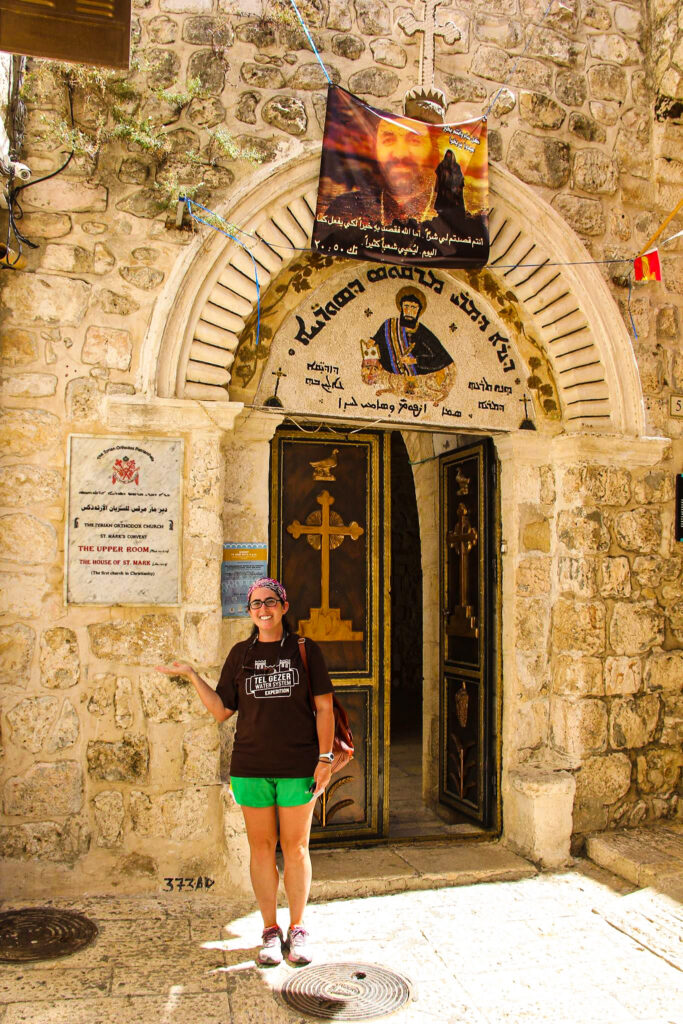
St. Mark’s Syriac Church is thought to be the location of the Last Supper, and has one of the oldest Syrian Orthodox Christian communities. You can visit the “room of the Last Supper” here – although remember, the current structure was only built in the 12th century CE over the remains of a church from the 4th century.
The Syrian Orthodox tradition holds that the Apostles chose this as the first church in Christianity because the Last Supper happened here. Other traditions believe that the Last Supper happened on Mt. Zion.
When I visited, I definitely felt the history of this place, which is what made it worthwhile!
8. Cathedral of St. James
The Cathedral of St. James dates back to the Crusader period and is on the World Monuments Fund, and the Armenian Quarter was built around this church as its centerpiece.
It was built in the 12th century over remains of a Georgian church from the 5th century CE. It’s one of just a few Crusader-era cathedrals to have survived basically in one piece, which is what makes it worth seeing.
This building also served as a refuge for Armenian immigrants and the poor since 1195, and throughout history the church has been extended and decorated.
Significance of the Armenian Quarter to Jerusalem
The Armenians created the first printing press in the city (1833), and the first photographic workshop (1855). They also had the first co-educational school in the city.
👉 Why is the Armenian Quarter separate from the Christian Quarter?
The Armenians consider this quarter to be part of the Christian Quarter. The Greek Orthodox, Latin and Armenian Patriarchates of Jerusalem, as well as Armenia’s government, have all expressed this sentiment.
It’s not so much the religion that differentiates this quarter from the others. Armenians are not Arab or Palestinian, and they have a unique language and culture.
Christianity became the official religion in Armenia in the 4th century AD, which is when many Armenians moved to Jerusalem. Then, in 1915, the war between Armenia and Turkey caused thousands of Armenians to flee to Jerusalem during the Armenian Genocide. This area is thought to be the oldest living diaspora community.
Four Quarters In Jerusalem: The Christian Quarter
The Christian Quarter is in the Northwestern corner of the Old City.
This quarter was built up in the 19th century, when several European countries constructed buildings here in a quest to expand their influence.
The Ottoman leaders tried to stop this from happening, but various leaders from Germany, Austria and other countries intervened. By the end of the 19th century, many Christians were making Holy Land pilgrimages and even more European countries built structures in the area.
Population: Around 7,000 Christians, mostly Arab Christians but also Greek Orthodox, Armenian Orthodox, Syrian Orthodox, Coptics, Ethiopians and more
Enter the Christian Quarter through the Damascus Gate, the Jaffa Gate or the New Gate.
Here’s what to see in the Christian quarter:
9. Church of the Holy Sepulchre

The Church of the Holy Sepulchre is the heart of the Christian Quarter and what everything was built around. It has been a Christian pilgrimage site for over 1,000 years.
The church is a main Christian pilgrimage site and there are both ornate areas and lesser-visited areas, all super interesting! The church itself has been through so much history.
Constantine I converted to Christianity and destroyed a temple of Venus in Jerusalem, where a tomb was found that people believed was that of Jesus. This became the location for the Church of the Holy Sepulchre.
What to see in this church:
- The Aedicula, a shrine with a room that has a relic called the “Angel’s Stone”, part of the stone that sealed Jesus’ tomb, and another room with the tomb of Jesus. This was the site where remains were found in 2016 from the time of Constantine.

- The “true cross”, discovered in 326 by Helena (Constantine’s mother)
- The site was also thought to contain the site of Golgotha, which was the hill on which Jesus was crucified.
From that time, a lot happened – the cross was stolen during the Arab Conquest and negotiated to be returned, the church was turned into a mosque at a point, and the church was even destroyed, then rebuilt.
The First Crusade happened largely to free the Church of the Holy Sepulchre from persecution. The Crusaders’ rebuilding is mostly what you’ll see today.
The last four stations of the Via Dolorosa are found inside the church, and you’ll also find numerous chapels with more legendary history, more tombs, architectural details and art, and more – I find this place really fun to explore and photograph!
The church today is owned by various entities, including the Roman Catholic, Greek Orthodox, Armenian Apostolic, Coptic, Syriac, and Ethiopian Orthodox churches. It’s really interesting to hear about their disagreements over who controls what!
10. Via Dolorosa
The Via Dolorosa means “Sorrowful Way” in Latin, also called the “Way of Suffering” in Hebrew and Arabic. It’s a processional route through various streets that Jesus is thought to have taken on the way to the cross. Many Christian pilgrims walk this route ceremonially, even carrying a cross. There are 14 Stations of the Cross on the route.
11. Muristan (Efthymios Marketplace)
The Muristan was built over ruins of a Hospital built by the Knights Hospitaller. Today, it’s a marketplace with around 70 shops, a baroque fountain and more.
12. Hezekiah’s Pool
“Hezekiah’s Pool” or Patriarch’s Pool, is a large reservoir that served as part of the ancient water system, that was from the time of Herod. It also might have been used as a stone quarry. It’s located near the Jaffa Gate, but it’s mostly in a residential area, so you may pass by and not see it!
13. More Churches & Cathedrals in the Christian Quarter
- Cathedral of Our Lady of the Annunciation (Melkite Greek Catholic church)
- Co-Cathedral of the Most Holy Name of Jesus (Latin Catholic church)
- Church of the Redeemer (Lutheran church)
- Holy Trinity Cathedral (Russian Orthodox church)
- Church of St John the Baptist (Greek Orthodox church)
14. Historic Monasteries in the Christian Quarter
- Deir es-Sultan (Coptic) is located on a roof of the Church of the Holy Sepulchre, on the Chapel of Saint Helena.

- Monastery of Saint Saviour (Franciscan)
- St. Abraham Monastery
15. Historic Mosques in the Christian Quarter
- Mosque of Omar (Mamluk) – this is located opposite of the Church of the Holy Sepulchre’s southern courtyard; you can see the minaret and the entrance from the street.
Significance of the Christian Quarter to Jerusalem
Eusebius‘ writings say that the early Christian church in Jerusalem was scattered once in 70 CE and again in 135 CE. However, from 70-130, the bishops of the church had mostly Jewish names, but after 135, they all have Greek names.
After Hadrian defeated the Jews in the Bar Kokhba Revolt (the 3rd major Jewish revolt mentioned earlier) and barred them from Jerusalem, that meant the bishops after that time were Gentiles.
Though Christians were persecuted for a time in the Roman Empire, around 66 AD, their significance in Jerusalem came back with the pilgrimage of Helena, the Roman Empress. She claimed to have found the cross that Jesus was crucified on, which was under a Temple to Venus she had removed.
The Brotherhood of the Holy Sepulchre was founded in 313 CE, which was also when Constantine the Great legalized Christianity in the Roman Empire.
Read even more about the sites in the Christian Quarter here.
Four Quarters In Jerusalem: The Jewish Quarter

The Jewish Quarter (HaRova HaYehudi in Hebrew) is in the Southwestern section of the Old City.
Size: 28.7 acres Population: Around 2,000 people, mostly Jews.
Enter the Jewish Quarter through the Zion Gate and the Dung Gate.
Here’s what to see in the Jewish quarter:
16. Western Wall / Kotel / Wailing Wall

The Western Wall (Kotel in Hebrew, also known as the Wailing Wall) is one of the most famous and historic sites in the Old City, because it’s all that’s left of the Jewish Temple that was destroyed in 70 CE by the Roman Army.
You must dress modestly for entry and go through security. Check all the rules here before your visit.
At the site, there are separate sides for men and women – but, if you go nearby to Robinson’s Arch, there’s a spot where all people can go to sightsee and pray, regardless of gender!
You’ll see people praying, and you can put prayers (pre-written, as you cannot write at the wall) in the cracks of the wall. You’ll also see bar mitzvahs going on at times, because this plaza is an official synagogue. On major Jewish holidays, it’s crowded.
You’ll also notice that people back away from the wall rather than turning their back on it, because of the holiness of the site.

17. Underground Western Wall Tunnel Tour

The Western Wall Tunnels can only be seen on guided tours. The entrance is in the same area as the courtyard of the Western Wall. There are a variety of tours you can choose from. This area is fascinating because it’s relatively new as a whole, and new discoveries are being made all the time!
This area was discovered by Charles Warren in the 19th century originally, and archaeologists continue to excavate. One of the most recent discoveries is the Roman Theatre structure where new courses of the Western Wall were uncovered by Dr. Joe Uziel, Tehillah Lieberman & Dr. Avi Solomon of the IAA.

You can also see the Struthion Pool, which is an ancient water reservoir built by the Hasmoneans, during the Western Wall Tunnel tour.
18. Robinson’s Arch

Robinson’s Arch is part of the remains of the Western Wall. It’s an arch that supported a flight of stairs at the southwestern corner of the Temple Mount, and a place where groups of Jews can go to pray who are mixed gender and more groups.
19. Temple Mount Sifting Project

The Temple Mount Sifting project is a major project that begun in 1999. It has uncovered the first archaeological data ever from beneath the Temple Mount – and you can participate (yes, you)!!
Because of the controversy surrounding the Temple Mount, it has never been excavated. The reason for the sifting is that in 1999, the Northern Branch of the Islamic Movement conducted illegal renovations, dumping 9,000+ tons of dirt containing archaeological artifacts that are now (sadly) removed from their original context.
Archaeologists Dr. Gabriel Barkay and Zachi Dvira saved the dump’s contents and started sifting it in 2004, which became the Temple Mount Sifting Project. Today, it’s an internationally recognized project that uses hundreds of thousands of volunteers to uncover all kinds of amazing finds!
With the finds, even out of context archaeological methods can be used to learn more about the time periods, usages and more of the items. Read more about this site and what kinds of items you can find here!
⛏️ Plus, learn how to volunteer on archaeological digs in Israel this year here!
20. Hurva Synagogue
The Hurva Synagogue is a historic synagogue that has a history that dates back to the First Temple period.
Hurva means ruin, and it was abandoned and damaged many times, including during the war in 1948, before most recently being rebuilt and dedicated in 2010.
21. Israelite Tower
The Israelite Tower is an archaeological site with remains from Jerusalem’s Iron Age fortifications, which were made into part of the Hasmonean city walls. This area was excavated by Nahman Avigad in the 1970s, with remains dating back to 586 BCE during the Babylonian destruction of Jerusalem.
Today a school exists over this area, but you can go on a tour by making an appointment. There are also stairs you must climb to reach the tower, where you’ll get amazing views!
There is a small entrance fee for this tour. To schedule a tour, call 972-2-6288141.
22. The Burnt House Museum

The Burnt House was excavated by Avigad in the 1970s, and it was the first time remains of residential areas surrounding the Western Wall had been excavated from their destruction in 70 CE by the Romans.
The Burnt House is what they found: a house that existed a meter below current walking levels, where there exists a kitchen, 4 bedrooms and a bathroom with a mikveh (Jewish ritual bath). The remains were covered in ash from the destruction, hence the name.
Today it is a museum where you can walk on clear floors and read information about the various areas.
23. The Broad Wall
The Broad Wall was also excavated by Avigad in the 1970s, and it is an ancient defensive wall from the 8th century, during the reign of King Hezekiah. The wall is seven meters thick, and remains are 65 meters long and 3.3 meters high at its highest points.
24. Herodian Quarter (The Wohl Archaeological Museum)
The Herodian Quarter (also known as The Wohl Museum of Archeology) is a residential area that dates back to the time of – you guessed it – Herod The Great. Six living quarters have been excavated and you can learn about what life was like for some of the wealthiest people during this time.
You’ll find mosaics, frescos, mikvehs, an engraving of a Temple Menorah, and household items among the finds.
It’s recommended to see this site through a guide, and you can check opening hours, ticket prices and more here.
25. The Byzantine Cardo

The Byzantine Cardo is an ancient Roman main street, with columns and shops. It was discovered on the Madaba Map of Jerusalem, a mosaic on a Byzantine church floor in Jordan.
There is a Roman period side, and a side from the Byzantine era that have been uncovered. You can also shop at the Crusader’s Bazaar, which has been renovated with modern shops!
26. Nea Church (Garden of Redemption)
The Nea Church, also known as the New Church of the Virgin Mary or New Church of St. Mary, was first consecrated in 543 CE by Emperor Justinian. It was one of the largest in the world at its time, and was connected to the Church of the Holy Sepulchre via the Cardo.
Archaeologists couldn’t find it until the 1967 excavations because it had been destroyed in an earthquake in the 8th century. Nahman Avigad, again, was the one who led the excavations in 1977 that uncovered this site.
Today, the archaeological remains of this church are part of the Garden of Redemption, or Gan HaTekuma in Hebrew.
27. Historic Mosques in the Jewish Quarter
The Sidna Omar Mosque is next to Hurva synagogue, and is a Mamluk-era Mosque that has been closed since the Six-Day War. The minaret is typical for the Mamluk era and is a part of the cityscape of the Old City!
The Al Dissi Mosque is a mosque from the Ayyubid era that is located right on the border between the Jewish and Armenian Quarters.
Significance of the Jewish Quarter to Jerusalem
This area has been home to Jews almost continuously since the 8th century CE.
During the reign of Hadrian: The Tenth Legion set up camp here and built structures like a Roman Bathhouse over the Jewish ruins.
During the 1948 war of Independence: The Arab legionnaires destroyed the Hurva synagogue and took some Jews captive before the quarter was razed.
After the 1967 Six-Day War: The Jewish Quarter began to be rebuilt as a residential neighborhood and tourism area, and the conservation project included archaeological excavations under the supervision of Nahman Avigad that uncovered many remains from the First and Second Temple periods, many of which you can see today!
Four Quarters In Jerusalem: The Muslim Quarter
The Muslim Quarter (Ḥāraṫ al-Muslimīn in Arabic) is in the Northeastern corner of the Old City and is the largest and most populated quarter.
Size: 77 acres Population: Around 22,000 people, including mostly Muslims and some Jews as well.
Enter the Muslim Quarter through the Damascus Gate, Herod’s Gate and Lions’ Gate.
Here’s what to see in the Muslim quarter:
28. Dome of the Rock & Al-Aqsa Mosque

The Dome of the Rock is an Islamic shrine within the Al-Aqsa Mosque compound, located on the Temple Mount. It’s the oldest surviving example of Islamic architecture in the world, built in 691-692 CE by the Umayyad Caliphate. It was built on top of the site of the Second Jewish Temple.
The original dome collapsed in 1015, and the current one was rebuilt in 1023.
Al-Aqsa Mosque was originally constructed by the Rashidun caliph Umar as a small prayer house, and was expanded by the Umayyad caliph Abd al-Malik and his son al-Walid in 705 CE along with the Dome of the Rock.
Note: Non-Muslims are not allowed to enter the interior of the Dome of the Rock, and it’s closed Fri-Sat and on certain Muslim Holidays.
29. Pool of Bethesda & St. Anne’s Church
The Pool of Bethesda is a Biblical site from one of the miracles of Jesus, where he healed the paralytic at the Bethesda Pool in the Gospel of John. It’s located near the Lion’s Gate and Temple Mount in the Muslim Quarter.
St. Anne’s Church is at the same site as the Pool of Bethesda. It’s the remains of a Byzantine-era church (12th century).
Significance of the Muslim Quarter to Jerusalem
This area was settled at the end of the 2nd Temple period, and a group of both Jews and Arabs fought off the Crusaders. However, the Crusaders kicked them out in the 12th century, and Syrian Christian Jacobites settled in the area.
Following Saladin’s conquest, Arabs moved back to the quarter in 1187, and Jews also moved in from Tzfat in the 1800s. The populations coexisted peacefully until the 1929 Palestine riots, when the Jews fled. They began returning to this quarter after 1967.
Four Quarters In Jerusalem: Tips & How to be prepared

Rules at Religious Sites
Dress: Most religious sites require modest dress, and you won’t be allowed in if you don’t follow the rules! Knees and shoulders should be covered.
Temple Mount: There are rules to enter the Temple Mount, including showing your passport and not wearing any religious icons like crosses, etc. You also aren’t allowed to pray on the compound if you observe a religion other than Islam.
What to bring specifically for the Old City
The Right Kind of Shoes
The Old City, and other areas in Jerusalem, have Jerusalem Stone that you’ll be walking on – and it can be really slippery, so you’ll want shoes with the best traction.
You’ll also be walking a lot, and there are a lot of hills. Good walking shoes, and possibly gel insoles, are your best bet!
I recommend hiking shoes or Chacos (sandals).
Water bottle cover
In Israel, it’s easiest to buy 1 liter water bottles, and most people buy a cover with a strap like this one to carry it around more easily!
Electrolyte packets
Touring in Jerusalem involves a lot of walking, hills and sun, and electrolyte packets like these are your best friend!
The right kind of hat
The sun in Israel – especially if you’re visiting in the summer – can be really harsh, and it gets hot. When you’re outside most of the time, it’s best to bring a hat that goes all the way around, like this one!
Sunscreen
Also, don’t forget sunscreen for all the reasons listed above!
Four Quarters In Jerusalem: Nearby Archaeological & Historic Sites
Jerusalem Walls National Park

Jerusalem Walls National Park includes the City of David, which is a must-see when you’re in the Old City! It’s right outside the walls near the Western Wall and Temple Mount Area and honestly, it’s one of my favorite places to visit in Jerusalem!
The City of David includes:
- Underground and indoor areas where you’ll see the excavations
- Siloam Pool
- “Hezekiah’s Tunnel” (also known as Siloam Tunnel or Shiloah Tunnel)
- Warren’s Shaft
- The Gihon Spring & fortifications
- Givati Parking Lot Excavations
- Nighttime light show
🐪 Check Prices for this City of David and Underground Jerusalem Day Tour Here
The Israel Museum

The Israel Museum is the main place to see artifacts and exhibits from sites all over Israel and beyond, including The Shrine of the Book, Mini Jerusalem, and so much more!
Check hours and visitor information here.
Mahane Yehuda Market
Mahane Yehuda is the main Shuk in Jerusalem. You can experience the outdoor market atmosphere, plus buy all kinds of spices, produce and more items!
Hutzot Hayotzer Artists Colony

Jerusalem Artist Colony, or Hutzot HaYotzer, is right outside the Old City Walls and is a wonderful area to visit! You can see artist galleries, shops and more on the picturesque streets here.
Ben Yehuda Street
Ben Yehuda Street is a historic, and popular street in downtown Jerusalem. It’s a pedestrian mall that’s a great place to shop during the day and eat and drink at night!
Rockefeller Archaeological Museum

The Rockefeller Archaeological Museum is the perfect spot to find more archaeological artifacts from the time of the British Mandate, organized chronologically.
Walk the Ramparts

Walking the ramparts is a hidden gem, but a really cool experience to see Jerusalem from above! There are two walks – the south side and north side – and once you begin, you can’t get off unless you’re okay not getting back in – so bring lots of water and a hat!
You can get tickets in the office at the Jaffa Gate, and you’ll also be able to use them for more sites including the gardens next the Western Wall.
The hours are: Sun – Thurs, 9am-4pm; Sat, 9am-4pm; Fri, 9am-2pm (except in summer, the south side closes at 7pm and the north side closes at 5pm).
Zedekiah’s Cave (Solomon’s Quarries)

Zedekiah’s Cave (Solomon’s Quarries) is the largest underground limestone quarry in Jerusalem. It runs under the Muslim Quarter (you enter outside of the quarter, between the Damascus and Herod Gates under the Old City Wall).
Hours: Sun-Thurs, and there’s a fee. You can get a guided tour.
Mount of Olives & Kidron Valley Sites

The Mount of Olives is known from many Biblical references, and is important in Judaism and Christianity. Sites & churches here include:
- Tomb of the Prophets
- Jewish Cemetery
- Lutheran Church of the Ascension
- Mosque or Chapel of the Ascension
- Church of the Pater Noster
- Garden of Gethsemane
- Church of All Nations
- Tomb of the Virgin Mary
- Grotto of Gethsemane
King David’s Tomb
King David’s Tomb is a sacred site on Mount Zion, and it’s a complex from the Crusader period in an old Crusader church. You’ll also find another room of the Last Supper here, and views from the roof of the Temple Mount!
Mount Scopus

Mount Scopus makes a fun hike, and it’s a great spot to get excellent views of the city of Jerusalem from the grounds of the Hebrew University. The National Botanical Garden of Israel is also on the University grounds.
Nearby, you’ll find the Tabachnik Garden next to the University. There are Second Temple period Jewish burial caves, as well as other cemeteries and two lookouts – one towards the Temple Mount, and the other towards the Dead Sea.
Yad Vashem
Yad Vashem is the World Holocaust Remembrance Center, and is definitely worth a visit. It was established in 1953 and has exhibits, as well as a research and education center for documentation. It’s located on the Mount of Remembrance in Jerusalem over 45 acres.

Jerusalem Trail (Israel National Trail)
The Jerusalem Trail is part of the larger Israel National Trail, a hiking trail that crosses Israel and National Geographic named as one of the best 20 hiking trails in the world! Then entire trail is around 683 miles long.
Where to stay in Jerusalem on any Budget
✅ Budget Option: Abraham Hostel Jerusalem
Abraham Hostel is a chain with multiple locations around Israel, and arguably the best budget place to stay in Jerusalem! They have a bar, game room, breakfast, events & more, and you can book a dorm, private room or apartment.
I’ve stayed here (plus the one in Tel Aviv), and I recommend it all the time to people!
🛏️ Check Availability at Abraham Hostel Jerusalem Here
✅ Mid-Tier Option: Bezalel Hotel (an Atlas Boutique Hotel)
Bezalel Hotel is a top-rated mid-tier hotel in a historic building is historic building with newer decor as well as breakfast and more amenities. It’s located near Mahane Yehuda, too!
🛏️ Check Availability at Bezalel Hotel Here
✅ Luxury Option: The American Colony Hotel
The American Colony Hotel is the highest-rated Luxury Hotel in Jerusalem. It’s a boutique hotel located in a historic building with a pool, fitness center, bar, walking tours and much more!
🛏️ Check Availability at The American Colony Hotel Here
Travel Planning Tips for Jerusalem
👉 For flights, WayAway is a flight aggregator that helps you find the cheapest flights. Use the code MUKI-TRAVELS for 10% off WayAway Plus.
👉 If you rent a car, just be prepared, especially for driving in Jerusalem. You’ll need to be an aggressive driver. To rent a car in Israel, Discover Cars is a great tool to use.
👉 Use the apps Moovit (for public transporation) and Waze (for driving directions).
👉 Find more tips on things like travel insurance, what to pack, and more on my travel resources page.
Four Quarters In Jerusalem: FAQs
👉 What are the 4 religions in Jerusalem?
Jerusalem, and Israel in general, has 3 main religions – Judaism, Christianity and Islam. The Armenian Quarter in Jerusalem is more cultural than religious, as the religion of the quarter is also Christian.
👉 Why is there an Armenian quarter in Jerusalem?
The Armenian quarter exists more for the culture than the religion, and many consider this quarter part of the Christian quarter. It’s thought to be the oldest living diaspora community, and while Armenians have been in Jerusalem for centuries, many fled here during the Armenian Genocide during the time of WWI.
👉 Why is there a Christian Quarter in Jerusalem and why is it important?
Several European countries constructed buildings in a quest to expand their influence in this quarter in the 19th century. The Ottoman leaders tried to stop this, but various leaders from European countries intervened. By the end of the 19th century, Christians were making pilgrimages and even more European countries built structures here.
👉 Is Bethlehem in Jerusalem or Palestine?
Bethlehem is located in the West Bank, Palestine, and the capital of the Bethlehem Governorate. It became part of Palestine in 1995 as part of the preparation for a two-state solution.
👉 What does 4 mean in Judaism?
Judaism, especially Jewish mysticism, practices spiritual interpretation of numbers, also known as gematria. Four is symbolic for multiple things, including:
- The four questions, four sons, & four cups of wine in the Passover Seder
- The four directions
- The four species waved in the four directions on the Jewish holiday of Sukkot
- Four Matriarchs of the Jewish Faith

All In All: Four Quarters In Jerusalem
I hope this guide helps you with the four quarters in Jerusalem! There’s practically endless history and archaeology to find all throughout Jerusalem and Israel, and a lot of amazing culture, food and people to meet in this amazing place where everything seems to converge!
Keep Reading:
👉 Check out more Israel guides & travel tips here!
👉 Christian Quarter Jerusalem: Insider Guide + Map
👉 Jewish Quarter Jerusalem: Insider Guide + Map
👉 Armenian Quarter Jerusalem: Insider Guide + Map
👉 Muslim Quarter Jerusalem: Insider Guide + Map
👉 8 Best Tours From Tel Aviv To Jerusalem To Check Out
👉 What To Pack For Israel In Winter (Dec-Feb)
👉 What To Pack For Israel In Spring (March-May)
👉 What To Pack For Israel In Summer (June-Sept)
👉 What To Pack For Israel In Fall (Oct-Nov)
👉 Is Jerusalem Worth Visiting? 26 Things To Do To Make Your Trip Worthwhile (with pros & cons)
👉 Is Israel Safe For Travel? Important Advice Amidst War
👉 David vs. Goliath: A Journey Through the Historic Elah Valley
👉 Winter in Jerusalem: Weather, Things To Do + Travel Tips
👉 The 41 Best Photography Spots In Jerusalem
👉 Jerusalem to Galilee / Galilee to Jerusalem: All You Need To Know
👉 Tel Aviv to Jerusalem / Jerusalem to Tel Aviv: All You Need To Know
👉 Jerusalem to Egypt / Egypt to Jerusalem: All You Need To Know
👉 Jordan to Jerusalem / Jerusalem to Jordan: All You Need To Know
👉 Israel To Palestine / Palestine To Israel: All You Need To Know
👉 Rome to Jerusalem / Jerusalem to Rome: All You Need To Know
👉 Going to Tel Aviv? Check out the 31+ Best Things To Do In Tel Aviv (With Map) Here!
👉 Where To Stay In Tel Aviv: Best Places for Every Budget (Neighborhoods, Hotels + More)
👉 Check out this post for where to stay in Haifa on any budget for each area!
👉 Renting A Car In Tel Aviv: Everything You Need To Know
👉 The Best Time To Visit Tel Aviv
👉 The 20 best day trips from Tel Aviv
👉 Is Tel Aviv Worth Visiting? 18 Ways To Make Your Trip Worthwhile (+ Pros & Cons)
👉 Is Haifa Worth Visiting? 38 Ways To Make Your Trip Worthwhile (+ Pros & Cons)
👉 Israel Archaeology: Volunteer On An Excavation In 2023
👉 Israel Archaeology List: learn about famous sites
👉 Israel & Palestine, and the Conflict: A Beginner’s Guide (History, Maps & Resources)
👉 The 17 Best Israel Souvenirs
👉 Top 25 Biblical Sites In Israel
👉 Captivating Scenes: A Photo Journey Through Historic Jerusalem
👉 10+ Unique and Captivating Photos of Tel Aviv, Israel
