
Armenian Quarter Jerusalem: Insider Guide + Map (2026)

The Armenian Quarter of Jerusalem (Hayots t’agh in Armenian), the smallest of the four quarters of Jerusalem, is located in the Southwestern corner of the Old City. Much of this quarter is uniquely Armenian, from the churches, to the food, holidays and pottery, but there are more sites and things to experience here as well!
Here are the top three places to visit in the Armenian Quarter:
- Cathedral of St. James
- The Tower of David
- The Mardigian Museum
Why listen to me? I lived in Israel for two years and have visited multiple times for tours and archaeological excavations. I earned my MA in Archaeology from Tel Aviv University, plus photographed archaeological sites for conservation and more!
This post will go over a bit of history, current events and everything to see in the Armenian Quarter, plus tips for visiting Jerusalem.

Planning Your Jerusalem Trip? Use my favorite resources:
Accommodation: Booking.com
Mid-Priced Hotel: Bezalel Hotel
Rent a Car: Discover Cars
Travel Insurance: Allianz
Flights: WayAway
Tour: All Inclusive Walking Tour Old City Jerusalem
eSIM: GigSky
The Armenian Quarter In Jerusalem Map (+ Bonus Places)
The Armenian Quarter In Jerusalem: Quick Facts
The roots of the Armenian Quarter in Jerusalem trace back to the pre-Christian era when King Herod built a fortress and palace along its western wall between 35-25 BCE.
Initially known as the Upper City or Zion, it endured the Roman occupation following the destruction of Jerusalem in 70 CE, becoming a government center under the Tenth Roman Legion.
The Quarter’s association with biblical narratives is evident in its possible identification as the Biblical Mount Zion. Following the Roman era, a small group of Jewish Christians returned to the remaining houses in the Upper City, only to be later expelled by Roman emperors.
Zion Gate, located along the southern end, stands as a testament to the Quarter’s historical significance. This gate leads to Hativat Ezyioni (Zion Street), running beside the Armenian cemetery and St. Savior Armenian Convent.
The Armenian presence in Jerusalem solidified in the 4th century AD, with monks and pilgrims settling near the Upper Room, considered a gathering place for early Christians. St. James Cathedral, believed to be on this site, and the adjacent St. James Monastery form the spiritual core of the Armenian Quarter.
By the 15th century, the Quarter gained recognition, evolving during the Ottoman rule in the 17th and 18th centuries. Unlike other Old City Quarters, it remains remarkably preserved, housing the St. James Convent, Patriarchate, and a vibrant community with churches, schools and historical monuments.
The 1948 Arab/Israeli war and the 1967 conflict took a toll on the Armenian Quarter in Jerusalem. During the initial war, some sought refuge within the St. James Convent, while others dispersed globally.
This upheaval left residences vacant, attracting vandalism. The 1967 war inflicted significant bomb damage, forcing the evacuation of buildings housing priests and seminarians.
Caught in the crossfire of regional conflicts, the Armenian Quarter’s future remains uncertain. Despite efforts by the Patriarchate to address property disputes, the Quarter’s precarious position raises fears about its continued existence and underscores the ongoing struggle to preserve its rich historical heritage in the heart of Jerusalem.
Once numbering over 16,000 in 1948, today, around a thousand Armenians reside in the Quarter, constituting one of the oldest Armenian communities outside Armenia. Amidst the complexities of East and West Jerusalem, the Armenians persist, guarding their cultural legacy and religious sites in this historically rich and contested enclave.
Size: 31 acres Population: Around 2500 people
Enter the Armenian Quarter through the Jaffa Gate or the Zion Gate.
The Armenian Quarter of Jerusalem: Places To Visit
1. The St. James Convent / Cathedral of St. James
Visiting the St. James Convent in the heart of the Armenian Quarter offers a unique and enriching experience for those exploring Jerusalem’s Old City. This historic convent, believed to sit on the site of the Upper Room, welcomes visitors with its architectural grandeur and spiritual significance.
The complex houses several churches, each adorned with intricate artwork and religious artifacts, providing a glimpse into the rich cultural tapestry of the Armenian community
The St. James Cathedral, considered the “Jewel of Churches,” stands as a testament to the enduring presence of the Armenian Apostolic Church in Jerusalem.
Guided tours offer insights into the convent’s history, highlighting its role as the spiritual epicenter of the Armenian Quarter.
Visitors can explore the library, museum, and the monument dedicated to the fallen heroes of the Armenian Legion in 1917, gaining a deeper understanding of the community’s contributions and struggles.
2. Armenian Museum (Mardigian Museum)
The Mardigian Museum recently reopened its doors after a comprehensive five-year renovation. Housed in a 19th-century building that served various purposes, including an orphanage for children who survived the Armenian genocide, the museum now stands as a testament to the rich and complex history of the Armenian community in Jerusalem.
The museum, which initially operated as a pilgrim guesthouse in the 1850s, tells the story of the Armenians’ enduring connection to the holy city, spanning centuries. Director Tzoghig Karakashian emphasizes its role as a passport for people to understand the Armenians and their integral part in Jerusalem’s history.
The reopening in late 2022 showcased a beautifully restored 5th- or 6th-century mosaic, discovered in 1894 on the grounds of an ancient Armenian monastery complex, serving as the museum’s centerpiece.
The exhibits, ranging from elaborately carved stone crosses to painted tiles and priestly vestments, not only showcase Armenian material art but also narrate the community’s remarkable story of survival.
The museum serves as a poignant memorial to the 1.5 million Armenians killed by the Ottoman Turks during World War I, emphasizing the importance of understanding and preserving this rich cultural heritage in the heart of Jerusalem.
Note: This museum may not be suitable for children, as there are graphic photographs displayed.
Museum hours: Mon-Sat, 9:30am-6:30pm
Ticket Price: 5 Shekels
3. Iconic Armenian-Turkish Ceramic Art

Armenian ceramics, with its distinctive artistry and craftsmanship, stands as a testament to the rich cultural heritage and artistic traditions of the Armenian people. Renowned for its vibrant colors, intricate patterns, and unique designs, Armenian ceramics have a history dating back centuries.
The art of Armenian pottery is deeply rooted in the region’s ancient civilizations, reflecting influences from Persian, Hittite, and Urartian cultures. Renowned for their mastery of the craft, Armenian artisans have continued these traditions through the ages, passing down their skills from generation to generation.
One of the hallmark features of Armenian ceramics is the use of traditional motifs, often inspired by nature, religious symbolism, and historical events. The iconic “Eternity Sign,” symbolizing the eternal nature of life, is a frequent motif, alongside depictions of flora, fauna, and intricate geometric patterns.
The city of Kutahya in present-day Turkey has been a significant center for Armenian ceramic production, renowned for its Kutahya tiles. These tiles, characterized by their vibrant glazes and elaborate designs, are a testament to the enduring legacy of Armenian ceramic craftsmanship.
Armenian ceramics serve not only as functional and decorative items but also as a means of preserving cultural identity. Today, contemporary Armenian ceramic artists blend traditional techniques with modern influences, creating a dynamic fusion of the old and the new.
Whether adorning homes with intricate tiles, crafting functional kitchenware, or producing decorative art pieces, Armenian ceramics continue to captivate with their timeless beauty and cultural significance, echoing the resilience and creativity of the Armenian people across generations.
4. The Tower of David

While the Tower of David primarily sits at the entrance of the Armenian Quarter in Jerusalem’s Old City, it is not directly located within the Armenian Quarter but rather in the adjacent Jewish Quarter. However, it remains a prominent landmark accessible to visitors exploring the historic neighborhoods.
The Tower of David, also known as the Jerusalem Citadel, offers a captivating journey through the city’s diverse history. The Tower serves as a museum, and its exhibits unfold within the ancient walls, presenting a comprehensive narrative of Jerusalem’s evolution from ancient times to the present day.
Visitors can ascend the tower and enjoy panoramic views of the Old City, providing a unique perspective on the interwoven quarters, including the Armenian, Jewish, Christian, and Muslim sectors. The exhibits within the Tower of David showcase various periods from the time of King David to the Ottoman era.
Here’s what you’ll see at the Tower of David:
- Two outdoor tour routes through the archaeological courtyard
- Moat
- The Kishle, an archaeological excavation area which has remains from the First Temple Period through modern times, including Herod’s palace, a Jewish factory from the Middle Ages, a prison & more
- 360° viewpoint from the Phasael Tower
- Nighttime sound & light show (additional cost)
- Tastings from Yalla Basta combined with Tower of David visit (additional cost)
Museum hours: Sat-Thurs 9am-4pm, Fri 9am-2pm (the museum stays open one hour past closing time). Check this page for ticket prices.

5. St. Mark’s Syriac Church
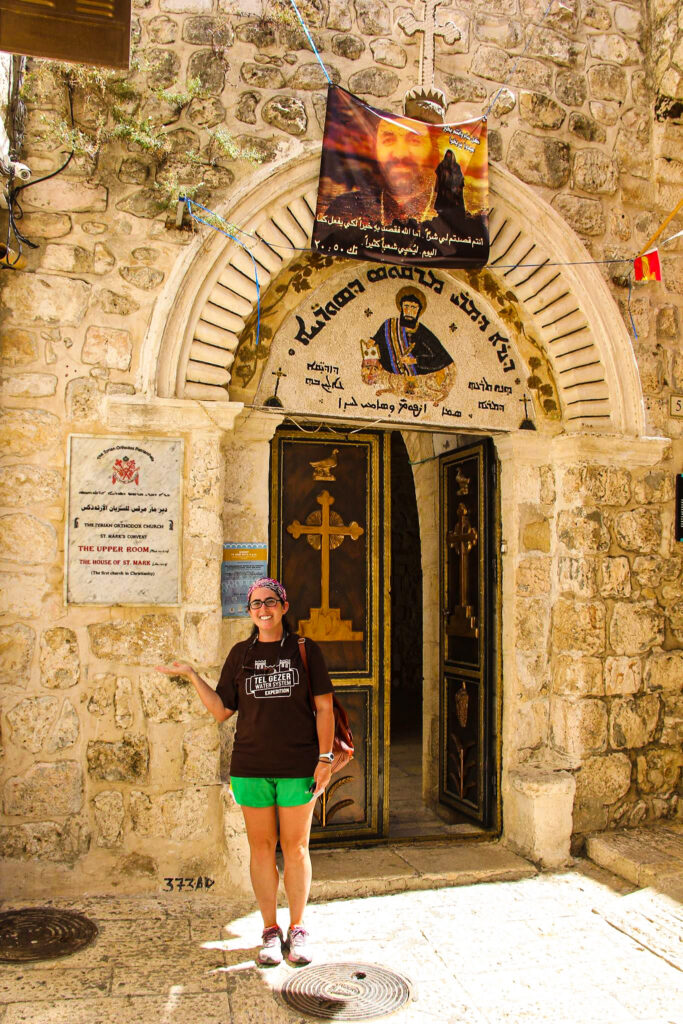
St. Mark’s Syriac Church in Jerusalem’s Armenian Quarter is said to be where the Last Supper took place, making it home to one of the oldest Syrian Orthodox Christian communities. You can explore the “room of the Last Supper,” although it’s essential to note that the current structure was built in the 12th century CE, replacing an older church from the 4th century.
The Syrian Orthodox tradition believes that this was the first church chosen by the Apostles because of its connection to the Last Supper. However, other traditions point to Mount Zion as the possible location.

6. Souvenir Shops
Shopping in the Armenian Quarter of Jerusalem’s Old City offers a unique experience, allowing visitors to discover authentic Armenian and Middle Eastern products. Here’s a list of items that are often unique to buy at the markets in the Armenian Quarter:
- Armenian Ceramics
- Armenian Carpets and Rugs
- Armenian Crosses and Religious Artifacts
- Armenian Jewelry
- Armenian Embroidery and Textiles, including scarves, tablecloths, and garments
- Traditional Armenian sweets, such as baklava, sujukh (walnut and grape molasses confection), and gata (sweet bread)
- Armenian Handmade Soaps and Cosmetics
- Armenian Books and Literature
- Armenian Crafts and Souvenirs
- Armenian Olive Oil and Spices
👉 Shopping Tips for the Armenian Quarter Market:
- Look for shops that emphasize the authenticity and quality of their products. Handcrafted items are often more meaningful souvenirs.
- Haggling is a common practice in the Old City’s markets. Feel free to negotiate prices with the shopkeepers.
- Seek out shops that support local artisans and offer unique, locally crafted items.
- Don’t hesitate to ask the shopkeepers about the significance of specific items or the history behind certain crafts.
- Keep in mind that shops in the Old City may have varying opening hours, especially on religious holidays and Fridays.
7. Restaurants – Armenian Cuisine
In addition to the churches, historical sites and market, the Armenian Quarter offers a delightful array of restaurants showcasing the rich and flavorful traditions of Armenian cuisine that is definitely something to try when you visit!
Armenian cuisine in Jerusalem is characterized by its use of fresh, high-quality ingredients and a harmonious blend of flavors. Here are some signature dishes you might encounter:
- Khorovats: Grilled meat skewers, often featuring lamb or beef, seasoned with aromatic herbs and spices.
- Dolma: Grape leaves stuffed with a flavorful mixture of rice, pine nuts, and herbs.
- Lavash: Traditional Armenian flatbread, thin and unleavened, served as a staple accompaniment to various dishes.
- Manti: Dumplings filled with spiced meat and topped with yogurt or garlic sauce.
- Harissa: A hearty porridge made from roasted wheat and meat, slow-cooked to perfection.

8. Holidays In The Armenian Quarter
The Armenian Quarter is a festive place on holidays. The Armenians follow the Julian calendar, which means they celebrate Christmas and New Year’s on distinct dates, creating a distinctively Armenian celebration!
Here are the holidays celebrated in the Armenian Quarter:
👉 Christmas: Christmas is a festive occasion in the Armenian Quarter, marked by pilgrimages, decorations, concerts, and services.
👉 Easter (Zatik): Easter, or Zatik in Armenian, is a significant religious celebration marked by special church services, processions, and festive gatherings. Traditional Easter dishes, including lamb and sweet pastries, add a culinary dimension to the celebrations.
👉 Feast of the Holy Cross (Khachverats): Celebrated on September 14th, the Feast of the Holy Cross commemorates the finding of the True Cross by Saint Helena. Pilgrims gather at St. James Cathedral for religious services, processions, and prayers.
👉 Independence Day (September 21st): Armenian Independence Day is a national holiday celebrated on September 21st, marked in the Armenian Quarter with cultural events, patriotic displays, and gatherings reflecting the community’s connection to Armenia.
👉 Assumption of Mary (Asdvadzadzin): The Assumption of Mary, observed on August 15th, is a significant Christian feast marked by special church services, processions, and events honoring the Assumption of the Virgin Mary.
👉 Vardavar: Vardavar, celebrated 98 days after Easter, involves joyful water fights associated with the Transfiguration of Jesus. Residents and visitors engage in water-based festivities, turning the streets into lively and refreshing celebrations.
These holidays collectively form a tapestry of cultural richness and religious devotion in the Armenian Quarter, providing a unique and immersive experience for residents and visitors alike.

All Inclusive Walking Tour Old City Jerusalem
A lot of the Old City can be tricky to navigate! This All Inclusive Walking Tour in the Old City of Jerusalem is a great way to get a guided tour of all four quarters with a professional guide in a small group and more, including:
- Western Wall & Temple Mount, including the Dome of the Rock
- Church of the Holy Sepulchure
- Lunch with complimentary tea or coffee
- Jaffa Gate
- Armenian Quarter
- Cardo
- Broad Wall
- Hurva Synagogue
- Golden Menorah
- Via Dolorosa
- Deir Al Sultan
🌟 Check out this 5-star review by John_T:
“Fantastic experience. Leontine’s (our guide) command of the history and culture is exceptional. The tour was perfectly paced and timed. The coffee and lunch stops were ideally located. Our guides ability to communicate thousands of years of multi-layered history into a perfectly understandable cohesive attitude was second to none. Exactly the experience we were looking for.”
🐪 Check Availability for This All Inclusive Walking Tour Old City Jerusalem Here

Significance of the Armenian Quarter to Jerusalem
In the intricate mosaic of Jerusalem’s history, the Armenian Quarter emerges as a trailblazer, leaving an indelible mark on the city’s narrative.
Pioneering initiatives underscore their historical significance, boasting the establishment of Jerusalem’s inaugural printing press in 1833 and the city’s premier photographic workshop in 1855.
Educational frontiers were pushed further with the inception of the first co-educational school, a testament to the Armenians’ commitment to progress.
👉 Why is the Armenian Quarter unique from the Christian Quarter?
Beyond being a part of the Christian Quarter, the Armenian Quarter stands as a distinct entity, a sentiment echoed by the Greek Orthodox, Latin, and Armenian Patriarchates of Jerusalem, along with the government of Armenia.
The essence of this distinction transcends religious boundaries; it is rooted in the Armenians’ unique identity — they have a distinct language, culture, and heritage.
The Armenian Quarter’s narrative intertwines with the fabric of Jerusalem from the 4th century AD, coinciding with Armenia’s embrace of Christianity. In 1915 during the Armenian Genocide, a diaspora community found solace in Jerusalem, birthing what is now considered the oldest living diaspora community.
The Armenian Quarter, beyond bricks and walls, echoes the resilience and cultural vibrancy of a community that has etched its story onto the soul of Jerusalem.
What To Consider When Visiting The Armenian Quarter
👉 Check before photographing religious sites and private neighborhoods. You’ll want to make sure entry and photographs are allowed into these areas.
👉 Middle East Culture. Jerusalem has a lot of religious people, and some areas of the city are where more religious populations live. Be mindful of these areas and dress modestly if you can while you’re in them. Also, people in the Middle East eat meals later, and stay out later at night in general – especially in the summertime!
👉 Language. Most people in Jerusalem speak English, but it’s still a good idea to familiarize yourself with basic Hebrew words and phrases! Check out this podcast for more, and this video to learn the Hebrew alphabet in a fun and easy way!
👉 Dress: Most religious sites require modest dress, and you won’t be allowed in if you don’t follow the rules! Knees and shoulders should be covered.
👉 Temple Mount: There are rules to enter the Temple Mount, including showing your passport and not wearing any religious icons like crosses, etc. You also aren’t allowed to pray on the compound if you observe a religion other than Islam.

What to bring specifically for the Old City
👉 The Right Kind of Shoes
The Old City, and other areas in Jerusalem, have Jerusalem Stone that you’ll be walking on – and it can be really slippery, so you’ll want shoes with the best traction.
You’ll also be walking a lot, and there are a lot of hills. Good walking shoes, and possibly gel insoles, are your best bet!
I recommend hiking shoes or Chacos (sandals).
👉 Water bottle cover
In Israel, it’s easiest to buy 1 liter water bottles, and most people buy a cover with a strap like this one to carry it around more easily!
👉 Electrolyte packets
Touring in Jerusalem involves a lot of walking, hills and sun, and electrolyte packets like these are your best friend!
👉 The right kind of hat
The sun in Israel – especially if you’re visiting in the summer – can be really harsh, and it gets hot. When you’re outside most of the time, it’s best to bring a hat that goes all the way around, like this one!
Sunscreen
An obvious necessity, but it can be hard to find a sunscreen that has only safe ingredients. I use Badger sunscreen because it only has four ingredients and is reef-safe, plus safe for my super-sensitive skin!
👉 This towel for the beach is perfect to avoid having to rent one, and you can also use it for yoga:
Daypack
You’ll want a daypack for exploring Jerusalem with your money, passport, extra clothing, sunscreen, water, souvenirs and more, that doesn’t weigh you down too much!
I’ve been using this packable daypack on trip after trip for the last few years, because it folds easily into a pouch that you can pack into a suitcase, it’s lightweight and waterproof, and it has pockets for water bottles and more things!

Where to stay in Jerusalem on any Budget
✅ Budget Option: Abraham Hostel Jerusalem
Abraham Hostel is a chain with multiple locations around Israel, and arguably the best budget place to stay in Jerusalem! They have a bar, game room, breakfast, events & more, and you can book a dorm, private room or apartment.
I’ve stayed here (plus the one in Tel Aviv), and I recommend it all the time to people!
🛏️ Check Availability at Abraham Hostel Jerusalem Here
✅ Mid-Tier Option: Bezalel Hotel (an Atlas Boutique Hotel)
Bezalel Hotel is a top-rated mid-tier hotel in a historic building is historic building with newer decor as well as breakfast and more amenities. It’s located near Mahane Yehuda, too!
🛏️ Check Availability at Bezalel Hotel Here
✅ Luxury Option: The American Colony Hotel
The American Colony Hotel is the highest-rated Luxury Hotel in Jerusalem. It’s a boutique hotel located in a historic building with a pool, fitness center, bar, walking tours and much more!
🛏️ Check Availability at The American Colony Hotel Here

Travel Planning Tips for Jerusalem
👉 For flights, WayAway is a flight aggregator that helps you find the cheapest flights. Use the code MUKI-TRAVELS for 10% off WayAway Plus.
👉 If you rent a car, just be prepared, especially for driving in Jerusalem. You’ll need to be an aggressive driver. To rent a car in Israel, Discover Cars is a great tool to use.
👉 Use the apps Moovit (for public transporation) and Waze (for driving directions).
👉 Find more tips on things like travel insurance, what to pack, and more on my travel resources page.

FAQs: Jerusalem’s Armenian Quarter
👉 What makes the Armenian quarter unique?
The Armenian Quarter is distinctive for its rich cultural heritage, encompassing the oldest diaspora community, unique language, and contributions such as the first printing press and photographic workshop in Jerusalem.
👉 What church is in the Armenian Quarter Jerusalem?
St. James Cathedral is the central church in the Armenian Quarter, housing the Armenian Apostolic Church’s Jerusalem Patriarchate, and serving as a spiritual and historical anchor.
👉 What are the 4 quarters of the Old City Jerusalem?
The Old City of Jerusalem comprises the Christian, Muslim, Jewish, and Armenian Quarters, each with its unique history, landmarks, and cultural significance.
👉 What is the history of the Armenian church in Jerusalem?
The Armenian Church in Jerusalem dates back to the 4th century AD, with Armenian monks settling after Armenia adopted Christianity. It has endured through centuries, surviving conflicts and contributing to the city’s religious landscape.
👉 Who are Armenians descended from?
Armenians trace their ancestry to the ancient Indo-European people who settled in the Armenian Highlands.
👉 Does the Armenian Church believe in Jesus?
Yes, the Armenian Apostolic Church is a Christian denomination that follows Orthodox Christianity and holds Jesus Christ as a central figure in their faith.
👉 What Bible does the Armenian Church use?
The Armenian Apostolic Church uses the Armenian Bible, known as the “Holy Scriptures” or “Bible of Saint Mesrop Mashtots,” translated into Armenian in the 5th century.
👉 What religion is Armenian Church?
The Armenian Apostolic Church is an independent Christian denomination that follows Orthodox Christianity, with its distinct liturgy and traditions.
👉 Who is buried in the Armenian Church in Jerusalem?
Notable figures, including some Patriarchs of Jerusalem, are buried in the Armenian Cemetery adjacent to St. James Convent in the Armenian Quarter.
👉 What DNA do Armenians have?
Armenians have diverse genetic backgrounds, but studies show a predominant genetic connection to the ancient Near East and the broader Eurasian region.
👉 What was Armenia called in biblical times?
In biblical times, Armenia was often referred to as Ararat, and it is associated with the biblical Mount Ararat.
👉 Are Armenians related to Egyptians?
Armenians and Egyptians belong to distinct ethnic and cultural groups, with no direct genetic or historical relationship.
👉 Are there still Armenians in Jerusalem?
Yes, a community of Armenians still resides in the Armenian Quarter of Jerusalem.
👉 What is the controversial Church in Jerusalem?
The Church of the Holy Sepulchre in Jerusalem is often considered controversial due to historical tensions among Christian denominations regarding its control and maintenance.
👉 What was the 2000 year old coin found in Jerusalem?
A 2,000-year-old coin found in Jerusalem, known as the “Half-Shekel,” is a historic artifact dating back to the Second Jewish Temple period.

All In All: The Armenian Quarter in the Old City of Jerusalem
In conclusion, the Armenian Quarter stands as a living testament to the enduring spirit of the Armenian people and their rich contributions to the tapestry of Jerusalem’s cultural heritage.
From the ancient St. James Cathedral, with its roots in the 4th century, to the modern Mardigian Museum showcasing the community’s resilience and history, the quarter encapsulates a narrative of faith, survival, and cultural vibrancy.
Despite facing historical challenges, the Armenians have left an indelible mark on Jerusalem, creating the first printing press and photographic workshop in the city.
As visitors wander through the narrow cobblestone streets, explore St. James Convent, or savor the unique offerings in the local markets, they are not merely tourists but witnesses to a living history that continues to unfold within the Armenian Quarter’s ancient walls.
Keep Reading:
👉 Check out more Israel guides & travel tips here!
👉 Is Israel Safe For Travel? Important Advice Amidst War
👉 8 Best Tours From Tel Aviv To Jerusalem To Check Out
👉 Is Jerusalem Worth Visiting? 26 Things To Do To Make Your Trip Worthwhile (with pros & cons)
👉 Jewish Quarter Jerusalem: Insider Guide + Map
👉 Christian Quarter Jerusalem: Insider Guide + Map
👉 Muslim Quarter Jerusalem: Insider Guide + Map
👉 David vs. Goliath: A Journey Through the Historic Elah Valley
👉 Winter in Jerusalem: Weather, Things To Do + Travel Tips
👉 The 41 Best Photography Spots In Jerusalem
👉 Jerusalem to Galilee / Galilee to Jerusalem: All You Need To Know
👉 Tel Aviv to Jerusalem / Jerusalem to Tel Aviv: All You Need To Know
👉 Jerusalem to Egypt / Egypt to Jerusalem: All You Need To Know
👉 Jordan to Jerusalem / Jerusalem to Jordan: All You Need To Know
👉 Israel To Palestine / Palestine To Israel: All You Need To Know
👉 Rome to Jerusalem / Jerusalem to Rome: All You Need To Know
👉 Going to Tel Aviv? Check out the 31+ Best Things To Do In Tel Aviv (With Map) Here!
👉 Where To Stay In Tel Aviv: Best Places for Every Budget (Neighborhoods, Hotels + More)
👉 Where to stay in Haifa on any budget for each area
👉 Renting A Car In Tel Aviv: Everything You Need To Know
👉 The Best Time To Visit Tel Aviv
👉 The 20 best day trips from Tel Aviv
👉 What To Pack For Israel In Winter (Dec-Feb)
👉 What To Pack For Israel In Spring (March-May)
👉 What To Pack For Israel In Summer (June-Sept)
👉 What To Pack For Israel In Fall (Oct-Nov)
👉 Is Tel Aviv Worth Visiting? 18 Ways To Make Your Trip Worthwhile (+ Pros & Cons)
👉 Is Haifa Worth Visiting? 38 Ways To Make Your Trip Worthwhile (+ Pros & Cons)
👉 Israel Archaeology: Volunteer On An Excavation
👉 Israel Archaeology List: learn about famous sites
👉 Israel & Palestine, and the Conflict: A Beginner’s Guide (History, Maps & Resources)
👉 The 17 Best Israel Souvenirs
👉 Top 25 Biblical Sites In Israel
👉 Captivating Scenes: A Photo Journey Through Historic Jerusalem
👉 10+ Unique and Captivating Photos of Tel Aviv, Israel
